













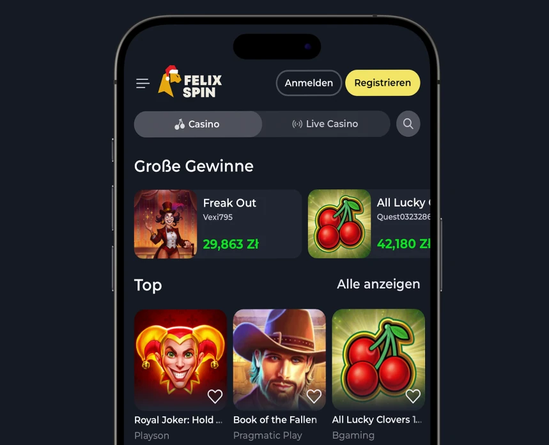
Why the Felixspin App Matters in 2026
When a platform is used primarily by phone, the first impression doesn't last long. An organized screen can impress in the first few seconds, but the real judgment comes when you look for your balance, open your profile, go to the cashier, and try to understand if the steps are truly linear. In 2026, many users in Italy use their account in a fragmented way: a few minutes in the morning, a quick check in the afternoon, a short session in the evening. In this context, clarity weighs more than graphics.
Imagine a simple scene. You're out and about, you have ten minutes free, and you want to see if the mobile environment is readable. If menus, balance, and personal area are found immediately, the experience starts well. If, however, you have to go back several times or interpret unclear screens, the problem is immediately apparent. A platform designed for mobile is not judged by how it looks. It is judged by how it truly usa, i.e., in short moments, with partial attention, and with the need not to waste time.
For those accessing from Italy, the most useful criterion remains practical: the service should allow orderly use, in compliance with applicable rules, and with reserved access for adults. There's no need to chase generic promises. It's important to understand if the account helps you log in, move around calmly, and exit without friction.
When the Phone is Truly Convenient
The phone is convenient when you already know what you want to do. Log in, check the balance, look at the history, have a short session, and then close. It becomes less convenient when you have to read a lot of information, clarify a doubt in the cashier, or fix profile data. Think about an ordinary evening: you open the account "just for a moment" and find yourself switching from one section to another without a clear direction. If the structure is clear, those minutes remain under control. If the structure is dispersive, the time spent increases, and the perceived convenience drops very quickly.